Whose Voice Are You Listening To?
That's exactly where Genesis 2 starts. God takes the adama, the ground, and forms Adam, a human being. Dirt and dust, shaped into a body. And then God does something extraordinary. He breathes into it. The dirt clod becomes alive – a human being.


Part Four: From the Beginning
I've held all three of my kids in my hands the moment they took their first breath.
It's breathtaking.
I've also stood by my grandmother's side when she took her last breath.
That was breathtaking, too, but in a very different way.
Theh, a little over a year ago, I was there when the pastor of the church where I was serving took his final breath too.
Birth and death.
A first breath and last breath.
Both were holy moments.
Both remind me that breath is a gift, not something we can give to ourselves, and not something we have much control over.
That's exactly where Genesis 2 starts. God takes the adama, the ground, and forms Adam, a human being. Dirt and dust, shaped into a body. And then God does something extraordinary. He breathes into it. The dirt clod becomes alive – a human being.
We are, all of us, God-breathed people.
Not self-made.
Not accidental.
Breathed into being by God himself.
At some point, though, God looks at that first human being and says something surprising: "It is not good for this man to be alone."
So God makes a helper.
For generations, that word "helper" has been used – intentionally or not, and with or without intent to harm – to shrink women down, confining them to be something less than that for which they were created.
Eve was created after Adam, from Adam's side, to be his assistant.
His servant.
His subordinate.
Not an equal.
Not a true partner.
But...here's the problem. That's not what the Hebrew actually says. The first description of the relationship between men and women give sa very different image.
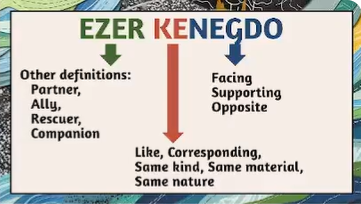
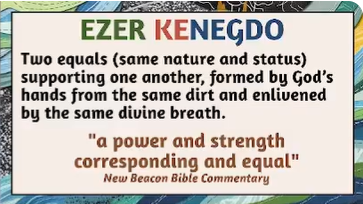
Ezer kenegdo.
Two words: Ezer means helper, that part's true. If we take a look through Scripture, however, this word does not describe a subordiate servant helper. In Psalm 121 we see, "I lift my eyes to the mountains. Where does my ezer come from? It comes from the Lord." God is called ezer.
Our helper.
Our rescuer.
That's not a subordinate role. That's the language of strength and rescue.
Then we come to kenegdo. It means something like "corresponding to" or "facing, opposite, equal to." Picture two boards leaning against each other. If you take one away, the other will fall. Make one board a lot bigger than the other, and they can't stand together either--the imbalance will topple them.
They only hold each other up when they're equal, facing one another, leaning into each other. Replace the two boards with people, and we see clearly that depending on each other to stand strong requires a great deal of trust, too.

That's the picture Genesis 2 gives us of the woman.
Not a servant.
Not a sidekick.
Instead, a power and a strength corresponding and equal to him, made from the same stuff, carrying within the same breath of God.
Paul picks this up centuries later in Ephesians 5:21, when he tells husbands and wives to "submit to one another out of reverence for Christ."
Mutual.
Equal.
They both look to Jesus as the example for how to treat each other.
I've done my best to live this out in my own marriage. My wife sees things I miss all the time. She hears things that pass right by me. She challenges me when I'm being foolish (which is more often than I'd like to admit). She supports me by opposing me, not to tear me down, but to build me up – a positive counter-balance.
That's ezer kenegdo.
That's partnership.
That's God's design.
This is so important in marriage, but it also applies in other relationships. It's how God designed us to live:
- leaning on each other,
- facing each other,
- needing each other.
None of us were commissioned to be a solo act. Not in your family. Not at work. Not in this church. We need each other – strengths, questions, encouragement, correction, and gifts.
So here's some homework:
- Think about the people that God has put beside you as you partner in life, work, and ministry – spouse, coworkers, friends, someone in your small group, your neighbor next door, etc.
- Ask yourself: Do I treat them as equal partners? Do I see them as people made in God's image? Do I let them challenge me? Do I value what they bring to our interactions, even when it's not my preference or when I don't agree?
Oh, and one more thing – look around and find one person you can begin to invest in.
- A younger believer who needs mentoring.
- A new Christian who needs someone to walk with them.
- A teenager who needs to know that there is an adult who knows their name.
We are God-breathed people, made for relationship with each other and with him. Two boards, leaning together – ezer kenegdo.
That's how we were built to stand.
If you enjoyed this article, please consider becoming a paid subscriber...or giving one-time "thank you" gift -- THANKS!
 Steven E Fairbanks
 Steven E Fairbanks