Waste Time With God
Prayer is the most strategic, the most productive, and the most life-giving thing you can do to start your day or to do throughout your day.


It might be the most valuable time of your day
A Simple Prayer
Before you read any further, I’d like to invite you to try something with me. Take a long, slow, deep breath and hold it for a moment. Then exhale slowly. Breathe in, and breathe out. Now, as you breathe in, pray, “Abba Father.” As you exhale, pray, “I belong to you.”
Again: Abba Father, I belong to you.
One more time: Abba Father, I belong to you.
I remember learning that prayer many moons ago when I was a student at Northwest Nazarene University. Brennan Manning came and spoke, and he taught us that very simple prayer. I’ve used it many times over the years: in times of stress or anxiety, when I wake up in the morning, or when I go to bed after a long day.
Just a few deep breaths — “Abba Father, I belong to you.”
It’s a short, simple prayer.
A Dull Axe
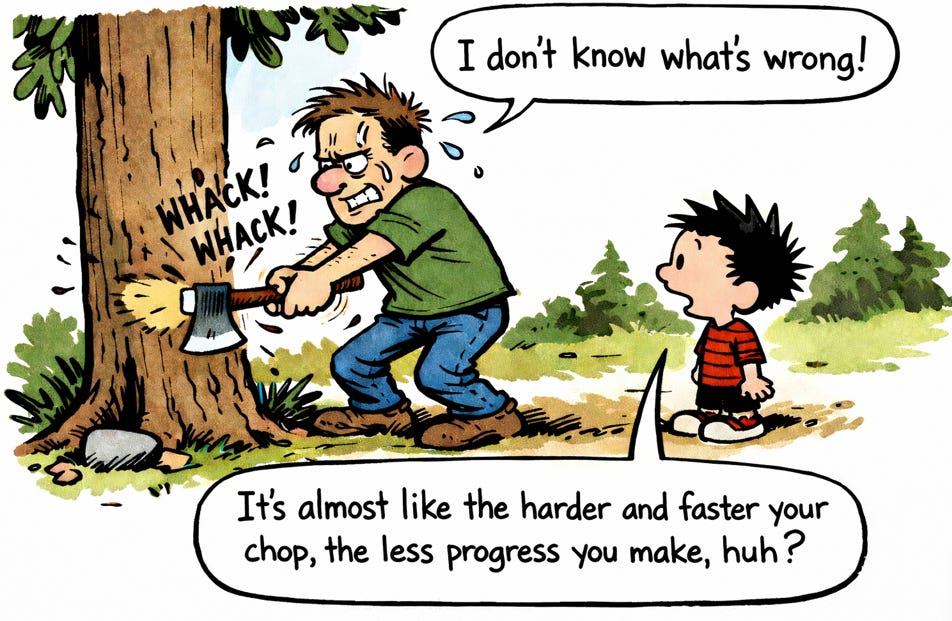
There’s a story about a dad who was cutting down some trees in his yard. The first tree came down pretty easily. Chop, chop, chop, and the tree was down. The second tree wasn’t so bad. By the third tree, he was working a little harder, but he finally got it down. By the fourth tree, he was really struggling. He said to himself, “I don’t know what’s wrong.” His son, who was out there watching, said, “It’s almost like the harder and faster you chop, the less progress you make.”
Have you ever felt like that in life?
The harder you try and the faster you go, the less progress you make?
The problem was that his axe was getting dull. The first couple of trees were fine because the axe was sharp. But the more he kept going, the duller the axe got, and the harder the work became. He could chop faster and harder and still make less progress.
I think sometimes we’re like that, aren’t we? We keep swinging harder and trying to go faster, and we find ourselves accomplishing less. Maybe I’m the only one. I don’t know. But part of the problem may be that we’re not keeping our tools sharp. Today I want to talk about one of those tools, and it’s a really important one.
Early on Their Knees
Let me ask you a question. What if one of the most productive things you could do in your day is something that looks very unproductive? What if the secret to getting more done is actually slowing down? Perhaps even starting your day on pause and not doing anything?
“The men who have done the most for God in this world have been early on their knees.” (E.M. Bounds)
Prayer is the tool I want to talk about. When we’re not building our lives on prayer, we can swing that axe harder and faster, only to realize we’re not getting much done.
Early on their knees, he says. Not early to their email. I’m not writing to any of you more than I’m writing to myself. Not early to your email, not early to the gym, not early to your daily grind, and not early to the to-do list that’s waiting. Early on their knees, in prayer. Early with the Lord.
I want to talk about prayer, but not as a religious duty, something we check off our list each day just because we have to. And not even the quick prayer we mumble before we eat. It’s good to pray before we eat, but I’m talking about something different.
I want to challenge you with this idea:
Prayer is the most strategic, the most productive, and the most life-giving thing you can do to start your day or to do throughout your day.
I want to challenge you to begin wasting time with God.
Not a Vending Machine
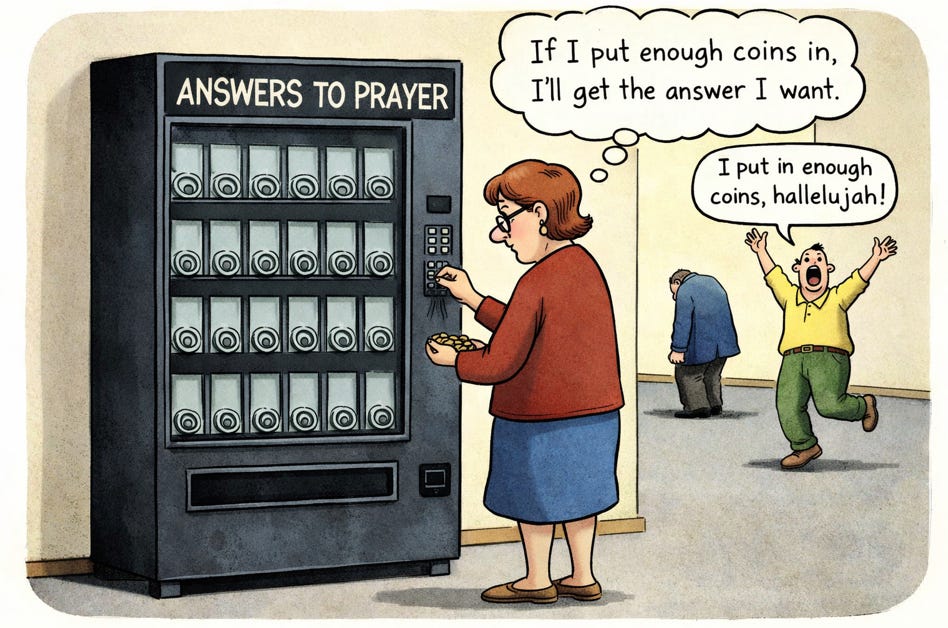
We often treat prayer like a vending machine. We walk up, put in our coins, and push the button for the answer we want. We hope that if we put in enough coins, we’ll get what we want. If we don’t, we start shaking or kicking the machine. And if the snack goes halfway down and gets stuck, we’re really frustrated because we know it’s on the way but not quite there. That’s when we really hit it hard. The whole idea is that if I do my part and put my coins in, God has to answer me. I hit the button, and I get what I want.
If you’ve been praying for very long, you’ve probably realized it doesn’t really work that way, does it?
Somewhere along the line, we have reduced one of the greatest privileges in the world — the ability to talk with the Creator of the universe — to a transaction. The Creator of you and me. The Creator of this world we live in. We’ve reduced that to, “If I put my coins in, I’ll get what I want.”
If I do my part, God, then you’ve got to do yours.
We sometimes forget that prayer isn’t just talking. It’s not calling up DoorDash, getting our prayer answered twenty minutes later, leaving a good tip, and being sure it will go the same way next time. Prayer doesn’t work like that.
Prayer is being with someone.
Prayer is a relationship with God.
Prayer is a connection with the Almighty.
Prayer is listening and being silent as much as it is talking and presenting your requests to God. We should present our requests, and Scripture tells us to, but that’s not all there is to it.
Prayer and Joy
Jesus said in John 16:24 that when we ask in his name, our joy will be complete. Philippians 4:4–5 says, “Rejoice in the Lord always. I will say it again: Rejoice! Let your gentleness be evident to all. The Lord is near.” Then, in 1 Thessalonians 5:16–18, we read, “Rejoice always, pray continually, give thanks in all circumstances.”
Prayer appears to be connected to our joy. Prayer is connected to how we live our lives in this world. Our joy, our fullness, and our satisfaction with life depend on prayer. They depend on our connection with Jesus, on our relationship with God, and on how we develop that relationship. It means sacrificing some of our production for a personal relationship that will accomplish far more than we could ever do on our own.
A.W. Tozer, a well-known theologian who wrote lots of books, said,
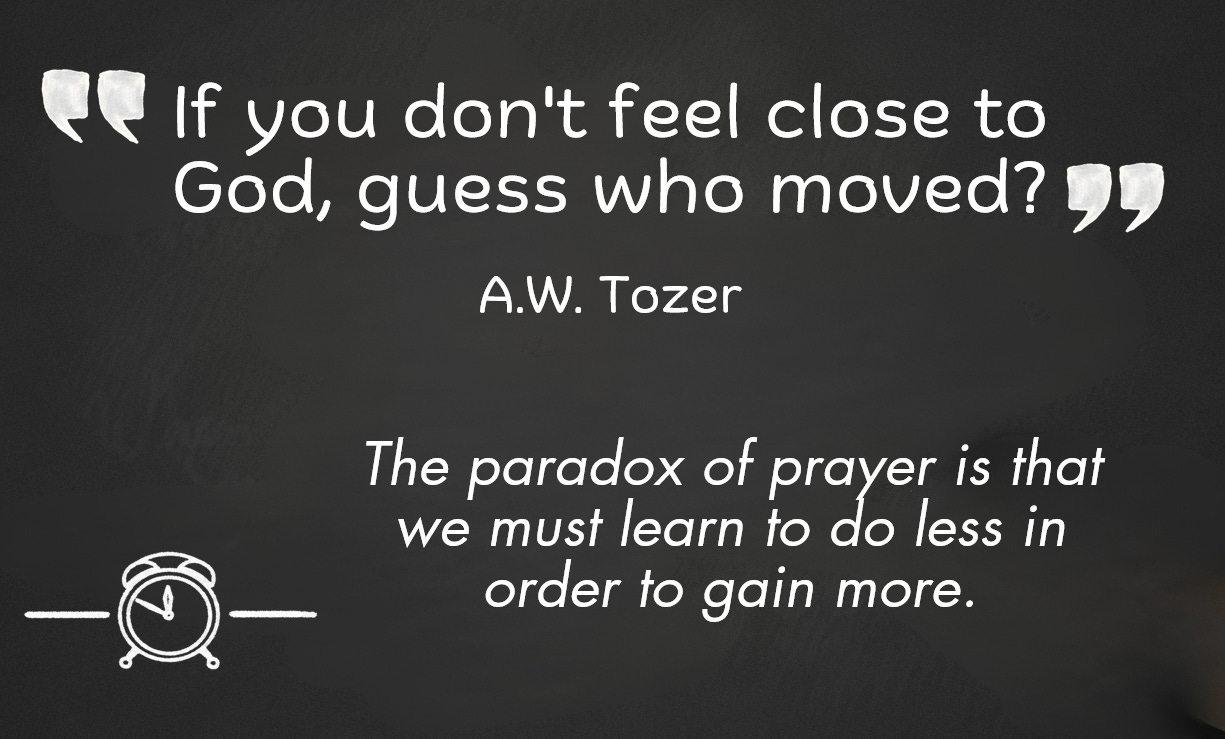
“If you don’t feel close to God, guess who moved?”
Ouch. I’ll give you a clue: it wasn’t God who moved away from you. It’s us who move away from God.
When Prayer Feels Unproductive
I think what stops many of us is that prayer sometimes feels unproductive. It feels wasteful. I could be doing so much more with this time. Instead of sitting here in silence or coming to the church at 7 a.m., I could be getting my to-do list done. I could be accomplishing things. We’re busy people. We’ve got important things to do.
Sitting quietly alone with God, or even praying with others, can seem unproductive, so we rationalize it. I can do more for God if I get to work, if I get going on my next sermon, or if I get going on this thing I have to do for the church. Then suddenly we realize at the end of the day that we didn’t spend any time just sitting with God.
You’ve been there, right?
Jesus himself, in the middle of his busiest ministry days, would often get away from the crowds and go up on a mountain to pray. He would stop and spend time with his Father, even in really stressful, busy times. If Jesus needed to slow down and be with his Father, what does that say about us, our calendars, and our to-do lists?
We also need to stop, get away, and spend time with our heavenly Father, with our Savior Jesus Christ, and in the Holy Spirit.
Prayer is kind of a paradox. We have to learn to do less in order to do more. Sometimes we have to step away, stop, and pause to accomplish what we really want and find joy and satisfaction.
Close to Jesus, Close to Each Other
Remember being a kid on the playground and picking teams? It was a fearful time for some of us. You didn’t want to be the last one picked.
As I read Scripture, Jesus seems like a really bad team captain. He didn’t pick a very good team. He picked a tax collector, someone who had sold his soul to Rome, a traitor to his own people. Then he chose a revolutionary, someone who was ready to take down Rome. He put them in the same room and said, “Come on. Let’s go. Let’s work together.”
He had Peter, the one Jesus said he would build his church on, and he had Judas, who we know would eventually betray him. He put all these guys in the same room and said, “Come on, follow me. We’re a team.” From the outside looking in, it doesn’t look like a very good team. He could have chosen better, don’t you think?
But I think that’s kind of the whole point. It wasn’t who they were that mattered. What mattered was that they were close to Jesus. They walked with him, followed him, and spent time with him over years. Somehow it worked out because they stayed close to Jesus.
No matter where people are in their lives today, moving closer to Jesus brings us closer to each other. We could take people from vastly different backgrounds, genders, occupations, languages, cultures, political persuasions, sexual orientations, and current relationships. We could take all the things that divide us, and the fact is, if we begin moving closer to Jesus, we begin moving closer to each other. The reverse is true, too. As we come together and walk together with Jesus, we grow closer to him and closer to our heavenly Father, and God’s will is done.
“Spending time with God is not...for the spiritual elite. It is the normal condition of the human soul functioning as God designed.” (Dallas Willard)
Spending time in prayer is what should be normal.
It ought to be our default.
But sin messes up our priorities, doesn’t it?
My desire as a pastor is that we would all surrender our lives to the Lord more and more each day. My desire is that we would allow the Holy Spirit to transform us from the inside out and shape us into a people who will impact our world for Christ.
Remain in the Vine
Jesus said it plainly in John 15:4–5:
“Remain in me, as I also remain in you. No branch can bear fruit by itself; it must remain in the vine. Neither can you bear fruit unless you remain in me. I am the vine; you are the branches. If you remain in me and I in you, you will bear much fruit; apart from me you can do nothing.”
We have two trees we bought last fall. One of them is starting to bloom, and it’s beautiful. The other one? Nothing. We watered them the same, so I’m not sure what the problem is. We’re kind of like that, aren’t we? If we remain in the Lord and the Lord in us, we will bear much fruit. We’ll blossom, and the fruit will be beautiful and delicious. But if we don’t, we’re just a dead tree sitting in the yard, not doing anything but getting in the way.
Apart from Jesus, we can do nothing. It’s not a threat. It’s just an honest assessment, and it’s the starting point for getting closer to Jesus. We have to be a people of prayer. We have to build our relationship with Jesus so that we are in him and he is in us.
Your value as a human being is not your talent, your productivity, the jobs you’ve had, the amount of income you’ve made over your lifetime, the rewards you’ve received, your wealth, or your position.
First and foremost, our value is found in our relationship with Jesus.
How near are we to him?
Are we remaining in him?
Are we abiding, staying, and not drifting away?
The Gentle Slope
It’s so easy to drift, isn’t it? C.S. Lewis described the road to hell as a “gentle slope, soft underfoot.” It’s not a rough ride. It just kind of happens. We forget to pray one day, then the next, and before we know it, it’s been a week, then a month. Then we stop and think, “Oh boy, when was the last time I seriously stopped and just spent time with the Lord?” That’s not a fun place to be, and I’ve been there. It’s not fun to realize it’s been a while.
Knowing God isn’t just part of Christianity. It is Christianity, and we know God through prayer and being with him.
The New Testament is clear that we know what God looks like by looking at Jesus. People ask, “What does God look like?” He looks like Jesus. “What is God like?” He’s like Jesus. According to the New Testament, Jesus is the fullest and most perfect reflection of who God is. There’s no one else who is even close.
Do you want to know what God looks like?
He looks like Jesus.
Do you want to know what God’s heart is like?
It’s like Jesus.
Do you want to know the kinds of things God likes to do and likes us to do?
Look at Jesus.
Christianity is about knowing Jesus, remaining in him, and bearing fruit. It’s not about knowing about God. A lot of us know about God. There are many people in churches who know a lot about God and can give you all the right Sunday school answers.
But do they know God?
Are they walking with him?
Are they abiding in him?
Are they remaining in him?
Keep Wasting Time Together
Remember back when you were dating? It was a long time ago for some of us. Remember how much time you wasted with that young man or young woman? Going on walks and doing all those things you never thought you’d be doing?
Playing silly games.
Playing footsies.
You know you’ve been there. If we stop for a moment, I think we can realize it really wasn’t a waste of time at all, was it? That’s what built the relationship. All the time you wasted together, when you could have been doing other things, is why you got married and why you’re still together today.
And if you’re still together today, hopefully you’ve realized that you need to keep wasting time together. You may not play footsies quite as often as you used to, and you may not have the same googly eyes, but you still need to keep wasting time together to keep the relationship going.
In the same way, we need to spend time with God: in prayer, talking, listening, singing, laughing, and worshiping, and in conversations with others when we share our story and what God has done in our lives. Like any relationship, you should avoid getting to the point where you stop wasting time together. It’s essential.
If you’ve known Jesus for a long time, hopefully you’ve come to realize that you have to keep spending time with him too.
You said a prayer forty years ago? That’s great. But spend time with Jesus today.
You went to the altar as a teenager? Great. What’s your relationship with Jesus today?
Learning to Love Prayer
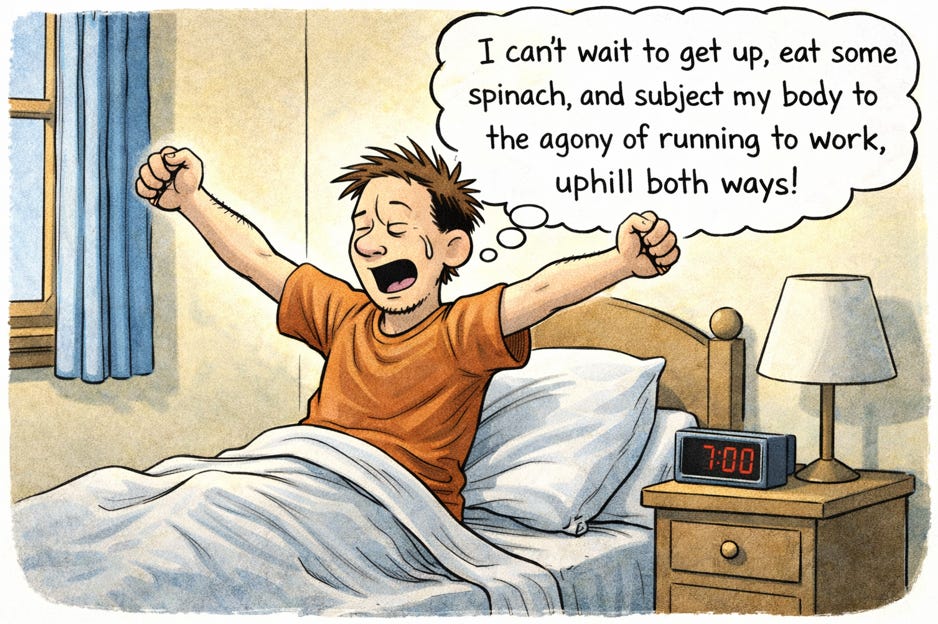
I don’t know about you, but I don’t always naturally love the things that are best for me. I don’t like getting up early to exercise. I don’t always crave the salad I know I should eat. I wake up thinking about coffee, sitting in my chair, checking my phone, and all the things I need to get started on.
Nobody starts an exercise routine because they love suffering. If you do, I don’t know what to say to you. Most of us don’t start exercising because we like the pain. We do it because we want some defined result, like a healthier body. If we stick with it, somewhere along the line we start to see some changes. Those first couple of weeks of a new routine are miserable. You get out of bed and can hardly move. But then you get to the point where you start to enjoy it. You want to get up and do it because you know the benefit that comes from it.
Prayer seems to work much the same way.
We learn to love prayer by praying.
We learn to love being a person of prayer by getting up and praying before we feel like it. Sometimes we just have to show up. Because if we wait until we feel like praying, we may never feel like it.
“Prayer is not monologue, but dialogue. God’s voice in response to mine is its most essential part.” (Andrew Murray)
I want to give you three practical tips for becoming a person of prayer.
1. Show Up
The first practical tip is to show up. This is true for most of life. Half the battle is just showing up, even when you’re not feeling it. You go for your walk even when you don’t want to. You pray even when you’re not feeling it. You do the right thing before you want to do the right thing.
If prayer is something you’re working on, pick a time, pick a spot, and start showing up. Bring your coffee or tea. Bring your tired self, whatever it is, and show up and pray, even if you don’t feel like it. On the morning when you wake up and everything in your body screams, “No! Thirty more minutes of sleep!” get up and show up. It’s easier said than done, I know.
The discipline comes first, and the delight comes second. You can read biographies of historical figures who had amazing prayer lives and think, “Look what God did through them.” But I can guarantee you they built that prayer life one ordinary day at a time. They got up early when they didn’t want to and got on their knees before the Lord. It wasn’t a fantastic story of spiritual highs where every day was a marvelous time of prayer. Most of it was mundane: showing up and doing it. So start today, even if you don’t feel ready.
2. Pray with No Agenda
The second tip is to pray with no agenda. This is a hard one. Most of us come to prayer with a list, don’t we? We may have a prayer journal, or a prayer wall with requests on it. God wants us to bring him our prayers and petitions. I’m not saying otherwise. But sometimes we also need to come to God without an agenda and just say, “Lord, here I am. I don’t know what to say today. I don’t know what to pray about. But I’m here.” Kind of like that prayer: “Abba Father, I belong to you,” whatever this day holds.
Learn to come to God without anything to ask for. Remember, he’s not a vending machine. Just come and sit, even if you don’t have any coins. No demands, no requests, no agenda. Just sit with God. Waste some time with God. Worship. Listen. Be still. Ask God what’s on his heart. Have you ever done that? “God, what’s on your heart today?” Treat God more like a friend and less like a vending machine.
Here are a few questions you can start with when you come with no agenda.
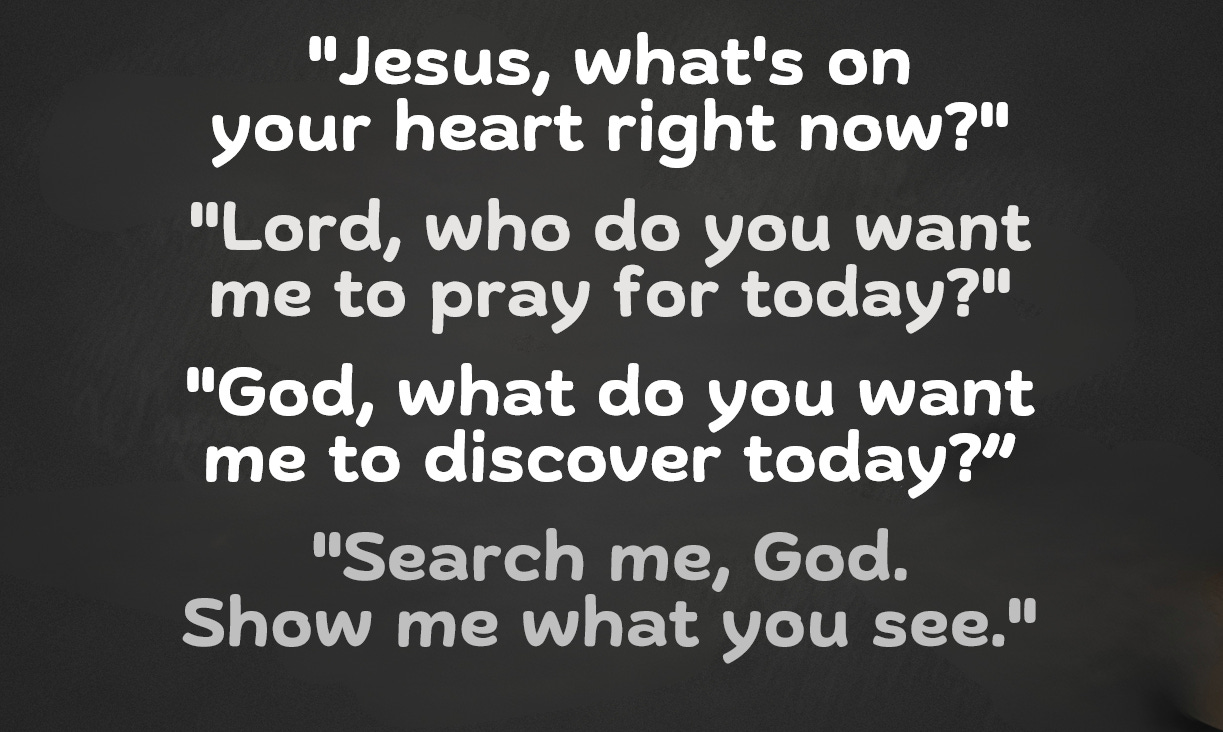
“Jesus, what’s on your heart right now?” I’ve got stuff on my heart, but Lord, let’s start with you. Tell me what you’re thinking about. Tell me what’s on your heart today. Then stop talking. Resist the urge to fill the silence. Some of us get really uncomfortable with silence, but learn to sit in it. You might be surprised at what comes up in the quiet: a person’s name, a nudge toward someone you’ve been avoiding, a situation you haven’t wanted to deal with, or maybe even a sense of peace about something that’s been worrying you. Don’t analyze it. Just receive it and respond accordingly.
“Lord, what do you want me to pray for today?” I’m here. I’m ready. Lord, show me what you want me to pray for today. Again, you may be surprised by the names and images that come to mind. Let God set the agenda. This practice can move your prayer life from routine to something remarkably personal. It’s kind of like when you sit down with your wife and ask, “How was your day?” You never know what’s going to come out. You talk about it, you think about it, and you pray about it.
“God, what do you want me to know about you today?” Lord, reveal something new about yourself to me today. Reveal something about yourself that maybe I don’t have quite right, or that I don’t even know yet or haven’t experienced yet. Invite God to reveal himself to you in a fuller way. We all understand God more and more as we walk through life, but none of us ever gets to the point where we have it all figured out. So ask, “Lord, what else do I need to know about you today?” Let those words or phrases settle on your heart. Sit in God’s presence and let him reveal himself to you.
“Search me, God.” Search my heart and let me know what you see. Is there something I need to give up? Something I need to surrender? Something I’m holding on to? Is there something I need to seek forgiveness for? Is there reconciliation I need to pursue? Lord, look in my heart and tell me what you see. That’s a scary thing to ask, because the Holy Spirit will show you something. Then have the courage to act on it. This is a vulnerable prayer. It’s an honest prayer.
A Broken and Contrite Heart
David was described as a man after God’s own heart. It wasn’t because of his military leadership, his warring ways, or any of those things. David was called a man after God’s own heart because of his broken and contrite heart. When he realized he was a sinner, he came before the Lord, knelt, prostrated himself, and said, “Lord, forgive me.” That’s what made him a man after God’s own heart.
We can be men and women after God’s own heart in the same way. It’s not about preaching great sermons or doing great things that everyone sees. We can get caught up in all the stuff that looks really good. But what makes us men and women after God’s own heart is a broken and contrite heart. When God reveals something to us, we don’t defend ourselves or put up walls. We say, “Yes, Lord. I have sinned. I need forgiveness. I need more of you in my life.”
Let me ask you to pause for a moment. Look back at that list of questions and pick one. Close your eyes and pray it right now. Give it a minute or so of silence.
Make it a part of your prayer life to ask questions like these from time to time, maybe in the morning while you’re still in bed or at night before you fall asleep. Begin asking questions like these and see how the Lord speaks to you.
3. Pray with Someone Else
The third tip is to pray with someone else. Personal prayer is essential, but it’s also important to find a person or a few people to pray with regularly: a spouse, a friend, a coworker, a small group member, or someone else. Make it a habit.
It doesn’t have to be formal or fancy. You don’t need an agenda. It doesn’t have to be long and complicated. But there’s a reason Jesus said, “Where two or three gather in my name, there am I with them.” When two or three gather in his name to pray, to sing, to worship, or whatever it is, he is there with them. So spend some time in prayer with two or three or more. Corporate prayer is really important. We pray together, walk together, and grow together.
Looking Like Jesus
Scripture tells us that the fruit of the Spirit is love, joy, peace, patience, kindness, goodness, gentleness, faithfulness, and self-control. This is what happens when we are close to Jesus. This is the fruit. These are the blossoms that come when we walk with Jesus, draw close to him, and make the effort to be in prayer and to remain in him so that he can remain in us. This is what we call the spiritual life, the transformed life, the Christlike life.
So once again I’ll ask: What does a sincere follower of Jesus look like? What does a Christian parent, leader, spouse, or teacher look like? What does a born-again child of God look like?
The answer is simple. They look like Jesus. We’re all still growing, but the longer we walk with him and the more we remain in him and he in us, the more abundant the fruit grows, the more fragrant it becomes, and the clearer his image is in us.
The disciples walked with Jesus, learned from Jesus, and had a relationship with Jesus. We can have the same thing. We can walk with him, learn from him, and have a relationship with him. And it starts with prayer.
We Cannot Give What We Do Not Have
“Everything starts from prayer. Without asking God for love, we cannot possess love and still less are we able to give it to others. . . . To be able to bring that peace, that joy and that love, we must have it ourselves, for we cannot give what we have not got.” (Mother Teresa)
I would agree. Everything starts from prayer. We can’t give it if we don’t have it.
I love the picture of God’s love being poured into us and splashing out to others. But it has to begin with it being poured into us, doesn’t it? That’s what gives us something to splash out to others. Love, joy, peace, patience, kindness, goodness, gentleness, self-control: we have to receive these. They have to grow in us first, and then they can splash out to the people around us. We cannot give what we do not have.

But remember this important part: we are not the source. God’s love doesn’t come from me. God is the data center, and I’m just the fiber optic line that carries it to someone else. God is the reservoir, and I’m the canal through which the water flows to someone else.
Reflection Questions
- What does your current prayer routine look like? How could you intentionally “waste time with God” this week by adding 5 minutes of silence or simply asking, What’s on Your heart, Jesus? ([24:20])
- Identify one area of life where you’ve been “swinging a dull axe” (striving without fruit). How might starting your day “on pause” in prayer refocus your dependence on Christ ([03:37])?
- Who is one person you could invite to pray with you regularly? What practical step (e.g., a weekly call, shared journal) could you take to prioritize this ([31:25])?
- The sermon warns against drifting from God ([15:42]). What habit or distraction most often pulls you away from abiding in Christ? How will you address it this month?
- Reflect on a time when prayer felt transactional (e.g., asking for outcomes without listening). How can you shift toward relational prayer this week, even in small ways?