Thirty Piece of Silver
Holy Week – Part Four – Spy Wednesday
We encounter a day of stark contrasts as we reach the midpoint of Holy Week. Known as "Spy Wednesday" in many traditions, this day commemorates one of the most troubling moments in the Gospel narrative: Judas Iscariot's agreement to betray Jesus. Yet alongside this act of ultimate disloyalty, we find a story of extravagant devotion that challenges our understanding of what Jesus truly deserves.
Two Responses to Jesus
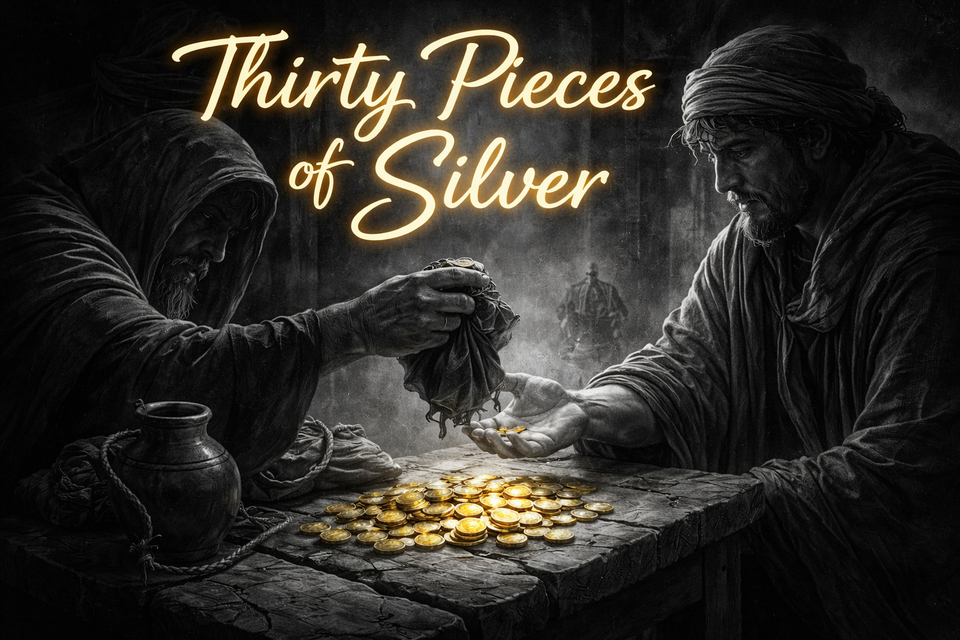
"Then one of the twelve, who was called Judas Iscariot, went to the chief priests and said, 'What will you give me if I betray him to you?' They paid him thirty pieces of silver. And from that moment he began to look for an opportunity to betray him." (Matthew 26:14-16)
"A woman came to him with an alabaster jar of very costly ointment, and she poured it on his head as he sat at the table. But when the disciples saw it, they were angry and said, 'Why this waste? This ointment could have been sold for a large sum, and the money given to the poor.'" (Matthew 26:7-9)
These two passages capture the tension of this day. In the first, we see Judas—one of Jesus' closest companions—coldly negotiating a price for betrayal. The thirty pieces of silver (roughly four months' wages for a laborer) represented what Judas thought Jesus was worth.
In sharp contrast stands the woman with her alabaster jar of perfume. This wasn't just any perfume—it was worth nearly a year's wages. Without hesitation, she breaks the jar and pours its contents over Jesus' head. While others calculate what was "wasted," she offers everything in a moment of pure devotion.
The juxtaposition is powerful: Judas seemingly values Jesus very little, while the woman recognizes His immeasurable worth. One person in that story is doing math. The other is doing worship.
Why "Spy" Wednesday?
The unusual name "Spy Wednesday" comes from the secretive nature of Judas' actions in this moment. After striking his deal with the chief priests, Judas began looking for an opportunity to betray Jesus away from the crowds. Essentially, he began "spying" for the perfect moment to turn Jesus over. Betrayal often works not through open opposition but through hidden calculations and secret compromises.
The Judas Within
Perhaps the most uncomfortable aspect of Spy Wednesday is how it invites us to see ourselves in Judas. That's not a comfortable position to be in, is it?
Few of us would openly betray Christ, yet we all know what it's like to calculate what following Jesus "costs" us—in comfort, wealth, status, or convenience. We understand the temptation to use our proximity to Jesus for personal gain rather than surrender and transformation.
We can understand, too, that betrayal rarely happens in a single moment—one big, bad decision. For Judas, the thirty pieces of silver were likely the culmination of a long process of disillusionment and self-interest. The Gospel of John hints that Judas had been stealing from the disciples' money (John 12:6), suggesting a pattern of small compromises that paved the way for the final betrayal. It's a sobering reminder that the road away from Jesus is usually not a sudden turn—it's a slow drift, one small compromise at a time.
When we find ourselves measuring out careful portions of devotion while holding back what matters most, we walk perilously close to the path of Judas.
Learning from the Woman with the Alabaster Jar
The counter-example to Judas is the woman with her alabaster jar. Her act seems impractical, excessive, even wasteful—and that's precisely the point. True devotion transcends practical calculation. She teaches us that Jesus deserves everything we have, not only our excess or that which we can conveniently spare.
Notice how she breaks the jar in Mark's account (Mark 14:3), ensuring nothing can be held back or saved for later use. It's all or nothing. While the disciples question her "waste," Jesus defends her extravagance: "She has done a beautiful thing to me" (Matthew 26:10).
There is something worth sitting with here: the disciples thought they were being responsible. They had good arguments—the poor, the money, the practicality of it all. But Jesus saw something they missed. Extravagant love for Him is never wasted. What looks foolish to the watching world can be the most beautiful thing in the room.
Going Deeper: Reflection Questions
Take a few minutes with these questions today. You might journal your answers, share them with a trusted friend, or simply bring them openly before God.
- Judas' betrayal didn't begin with thirty pieces of silver—it began with a pattern of small compromises. Is there an area of your life where you've been making small concessions that are slowly pulling you away from wholehearted devotion to Jesus? What would it look like to honestly address that this week?
- The woman with the alabaster jar gave something costly and irreplaceable—and she gave it all. What is the most precious thing you're holding back from God right now? What would it mean to break your "jar" and offer it fully to Him?
- The disciples called the woman's offering a waste, but Jesus called it beautiful. Are there ways you've let the opinions of others shrink your worship or your generosity? How might you respond to Jesus more freely this week, regardless of what anyone else thinks?
A Prayer for Spy Wednesday
Lord, guard my heart from betrayal and teach me the extravagant devotion of the woman who held nothing back from You. Help me recognize the subtle ways I calculate what following You will "cost" me. When I'm tempted to sell out for comfort, popularity, or security, remind me of Your immeasurable worth. Break my alabaster jar of self-protection so that I might pour out everything in wholehearted worship. Amen.
In what ways do you struggle between calculated devotion and extravagant worship? Share your reflections in the comments below.
"Thirty Pieces of Silver" Song
Enjoy two versions of an exclusive song, "Thirty Pieces of Silver."
Verse 1
The lamps burn low in Jerusalem
Whispers fill the night
Shadows lean against the walls
Where secrets hide from light
A quiet deal behind closed doors
No crowd, no trumpet sound
Just the rustle of a money bag
As silver spills around
Pre-Chorus
Thirty coins upon the table lie
Cold as winter rain
Every clink a quiet echo
Of a heart that turned to gain
Chorus
Thirty pieces in the dark tonight
Silver shining pale in candlelight
For the price of prophecy foretold
A faithful kiss is quietly sold
Oh the blindness of a hungry soul
Trading truth for fleeting gold
While heaven watches silently
Thirty pieces in the dark
Verse 2
The priests speak low in careful tones
Their plan begins to grow
They fear the crowds, they fear the truth
But hatred makes them bold
And Judas stands between two worlds
Where loyalty once lived
A pocket heavy now with coins
For something God would give
Pre-Chorus
Somewhere prophets long ago
Wrote the price that would be paid
Silver weighed for righteousness
And thrown where shepherds prayed
Chorus
Thirty pieces in the dark tonight
Silver shining pale in candlelight
For the price of prophecy foretold
A faithful kiss is quietly sold
Oh the blindness of a hungry soul
Trading truth for fleeting gold
While heaven watches silently
Thirty pieces in the dark
Bridge
Did the night grow colder when the bargain fell?
Did the silence tremble like a warning bell?
The Shepherd walks while wolves conspire
Yet every step fulfills the fire
For love already knows the cost
Before the silver’s ever tossed
Final Chorus
Thirty pieces in the dark tonight
Silver glimmering without a light
What men have planned in secret halls
Still moves within the greater call
Though betrayal stains the midnight air
And treachery is everywhere
The dawn will break eventually
Beyond the silver in the dark
Outro
Coins still echo in the quiet room
As Wednesday fades to coming doom.
[This song represents a creative collaboration between myself, Chat GPT, and Suno AI]




Member discussion